First-Party Data in Retail: From Anonymous Baskets to Customers
The real gap in retail is the anonymous basket. Here is how to turn it into known customers.
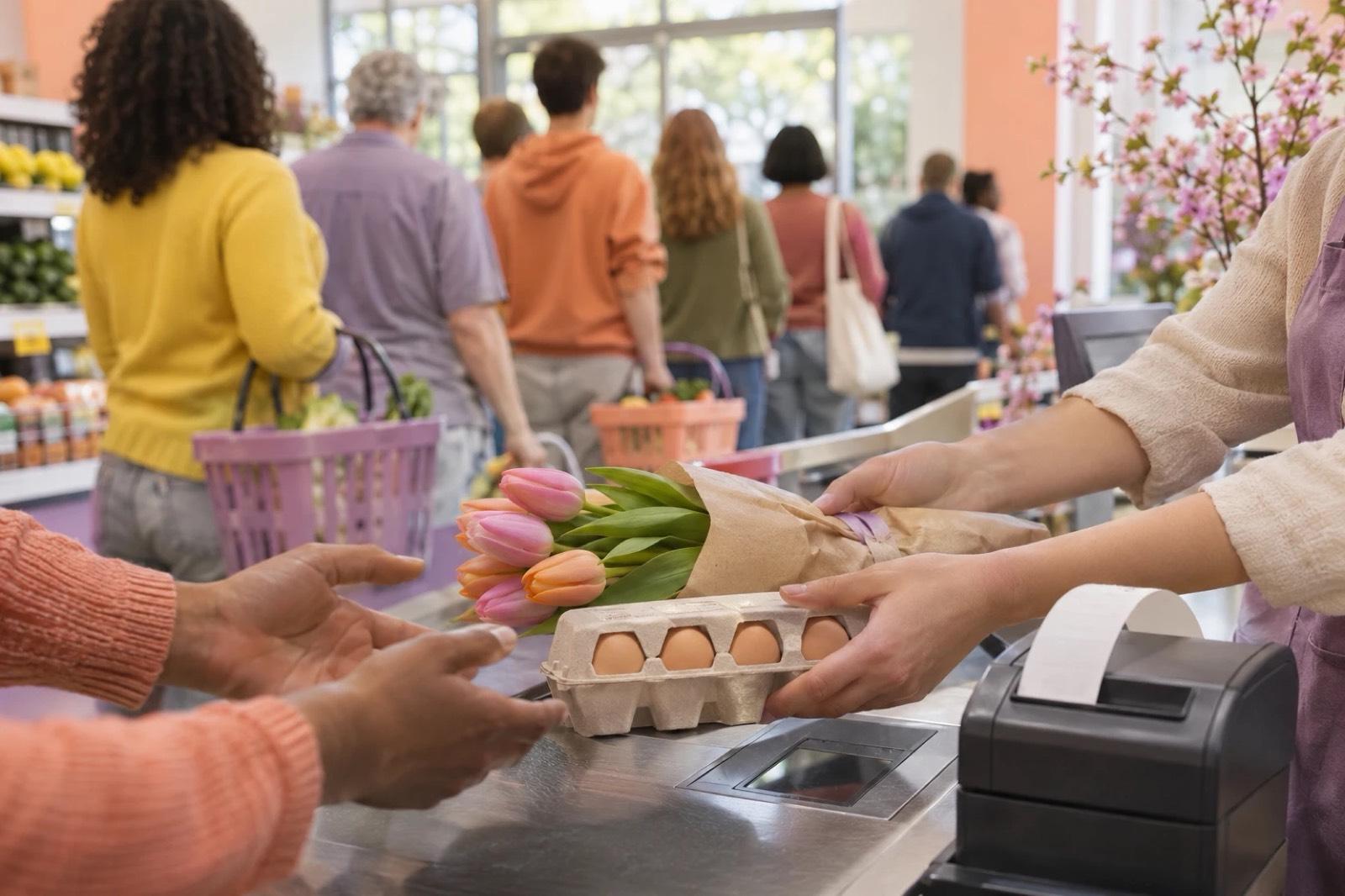
First-party data is information a business collects directly from its own customers through its own channels: purchases, loyalty sign-ups, app activity, website visits, service conversations and survey answers. You own it, you know where it came from and, when it is gathered with consent, you can use it to recognize, serve and reward each customer.
Most guides to first party data are written for advertisers and talk about cookies. But if you run a supermarket, a fashion chain or an FMCG brand, your biggest gap is not a missing cookie. It is the basket that left the store with no name attached.
What is first-party data in retail?
In retail, first-party data is every purchase, visit and interaction you can link to an identified customer. The transaction matters most, because it shows what people actually buy, how often and at what price.
For a grocer, that means the in-store receipt linked to a loyalty member, the online order and the redeemed app coupon. For a beauty brand, it includes the receipt a customer scanned after buying its serum at a pharmacy.
The common thread is a known person. A sales report tells you how much milk a store sold last week. First-party data tells you which households stopped buying milk from you, and that is the question that leads to action.
First-party vs third-party data (and zero- and second-party)
The four types differ in who collects the data. Zero- and first-party data come straight from your customers, second-party data is a partner's first-party data shared with you, and third-party data is bought from aggregators.
| Type | What it is | Retail example | How reliable | Who owns it |
|---|---|---|---|---|
| Zero-party data | Information a customer tells you on purpose | Preferred store, dietary needs, sizes, birthday, "I shop for a family of five" | High intent, but can go out of date and people sometimes guess | You, with the customer's consent |
| First-party data | What you observe directly in your own channels | Receipts linked to a loyalty ID, online orders, app use, coupon redemptions | Highest, because it records real behavior | You |
| Second-party data | Another company's first-party data shared with you under an agreement | A retailer sharing category sales by segment with a supplier brand | Good, but limited to what the partner chooses to share | The partner, licensed to you |
| Third-party data | Data bought from aggregators who collected it elsewhere | Demographic or interest segments bought for ad targeting | Lowest; often modeled, broad and hard to verify | The data seller |
Zero-party data is a subset of first-party data: the part the customer volunteers. But what people say and buy often differ. Someone who checks "healthy eating" may still buy chips every Friday, so weight behavior above stated preference.
Why does first-party data matter more now?
First-party data matters more because the alternatives are getting weaker, costlier or more regulated.
Third-party signals are less dependable
Safari and Firefox already restrict third-party cookies by default, and mobile platforms limit app tracking. Google changed course on removing them from Chrome, and in April 2025 Google said it would keep its current approach to cookie choice in Chrome rather than introduce a new prompt. Either way, a strategy built on someone else's tracking rests on decisions you do not control.
Paid acquisition keeps getting harder to justify
Every customer you win again through advertising costs money a recognized, returning customer does not. Our guide to customer retention strategies for retail covers that side in depth.
Retail media runs on known customers
Retailers increasingly sell audiences and closed-loop measurement to supplier brands. That only works if you can prove the shoppers who saw an offer went on to buy. Anonymous baskets cannot prove that.
Privacy law rewards clean, consented data
Data protection laws in Europe, the Gulf and elsewhere require a clear legal basis, often consent. Data you collected yourself, with a clear notice and a consent record, is far easier to defend than a bought list.
The retail problem is anonymous baskets, not cookies
In a physical store, most transactions are anonymous until the customer is identified at checkout. The receipt data is there, line by line, but without a name it links to no person, history or next offer.
Online, every order needs an email and a delivery address, so identity comes almost free. In store, the cashier has a line and the shopper has a full cart. Unless something prompts identification, the sale is recorded against nobody. For most omnichannel retailers, the richest customer data covers the smallest channel.
How customer identity leaks
Even retailers with a loyalty program lose identity in more ways than they expect:
- The card left at home. She is a member, but not today, so the basket goes unrecorded.
- Cash and quick visits. A quick fill-in trip paid in cash at a busy hour rarely gets a loyalty scan.
- One account, many shoppers. A family shares one number, so a teenager's snacks mix with a parent's weekly grocery run and personalization misfires.
- Different IDs in different channels. A phone number in store, a work email online, a guest checkout in the app: three partial profiles.
- Purchases through someone else's checkout. An FMCG brand sells through supermarkets. The retailer has the receipt; the brand has nothing.
- Staff shortcuts. A cashier scans a store card to give a customer the discount, quietly corrupting the data.
Customer identity resolution fixes these leaks: matching phone number, email and loyalty ID to one person, separating households where it matters and merging duplicates. It is unglamorous, but every use of the data depends on it.
How do retailers capture first-party data at checkout and beyond?
Retailers capture first-party data by giving customers a quick, worthwhile reason to identify themselves at each point of purchase. Each method differs in cost, coverage and quality, so combine several.
| Capture method | Best for | Strengths | Trade-offs |
|---|---|---|---|
| Loyalty ID scanned at the point of sale | Retailers who own the checkout | Full basket at line level, tied to a member | Depends on cashier prompting |
| Phone number at checkout | Grocery and high-frequency shopping | Nothing to carry; fast to enroll | Typing errors, shared family numbers, slower queues |
| E-receipts | Fashion, electronics, home | Clear customer benefit; captures an email or number and consent in one step | Needs POS integration and a clean consent wording |
| App scan or scan-and-go | Engaged, frequent shoppers | Identity is automatic; rich behavioral signals | Only covers app users; download is a hurdle |
| Receipt scanning | FMCG brands and distributors that do not own the checkout | The only way for a brand to see purchases made at other retailers | Needs customer effort, a strong reward and fraud checks |
| Wi-Fi login, registration and service forms | Malls, large-format stores, service desks | Captures contact details and visit patterns | Usually no basket data; details can be fake |
TipMeasure identification rate by store and by cashier, not only in total. The gap between best and worst stores is usually training and checkout flow, which costs far less to fix than a new campaign.
The trade-off nobody mentions is friction at checkout. The best capture flows ask for one identifier, accept it in any form (card, app, phone number) and confirm the reward on screen, so the customer sees why it was worth it.
Turn anonymous baskets into known customers. Valus Loyalty captures transactions on every channel and ties them to a known person, including receipt scanning for brands that sell through retailers, so store, web, app, kiosk and call center activity lands on one customer record. See how the platform handles customer identity.
What makes customers share their data? The value exchange
Customers share data when they get something immediate, relevant and fair in return, and trust you to use it well. Ask for more than you give and they skip the scan or give a fake number.
Think of it as a ledger. You ask customers to identify themselves every visit, share preferences and accept messages. In return, give them:
- Money back: points, cashback or member prices visible on today's receipt.
- Convenience: e-receipts, paperless returns, faster checkout.
- Relevance: offers on what they actually buy, not generic flyers.
- Recognition: tiers, early access, birthday treats.
- Control: a clear view of what you hold and an easy way to opt out.
A common mistake is asking for everything at sign-up. Collect the minimum at checkout (a phone number and consent), then ask for preferences in small steps and reward each one. Valus Loyalty can reward behavior beyond spend, such as completing a profile, scanning a receipt or writing a review, so sharing data becomes part of the program.
How do you turn first-party data into value?
You turn first-party data into value by building one profile per customer, grouping customers by behavior, acting with relevant offers and measuring against customers you did not target.
One customer profile
Bring every identified transaction into a single record across store, web, app, kiosk and call center. That is what most people mean by a first party data platform; what matters is that the record is complete, de-duplicated and current.
Segments that reflect behavior
Start with recency, frequency and spend, then move to segments that predict what happens next, such as customers likely to lapse. Our article on moving from RFM segmentation to predictive segments walks through that progression. As an illustrative example, a "Lapsing VIPs" segment might be customers with lifetime spend above a set threshold, no purchase in 90 days, who opened the last email.
Personalization people notice
Use the profile to change the offer, the timing and the channel. A parent who buys diapers every two weeks and has missed a cycle deserves a voucher more than everyone on a broadcast list.
Measurement you can trust
Known customers can be compared with similar customers who did not get an offer, so you measure incremental sales rather than guess.
First-party data and privacy in the GCC: Saudi Arabia and the UAE
Saudi Arabia and the UAE both have national personal data protection laws that put consent and transparency at the center. Plan consent wording, retention and data location from day one. This is a practical summary, not legal advice; check details with your counsel.
Saudi Arabia: Personal Data Protection Law (PDPL)
Saudi Arabia's Personal Data Protection Law is overseen by the Saudi Data and Artificial Intelligence Authority (SDAIA). It came into force in September 2023 and, after a one-year grace period, became fully enforceable in September 2024, as Clyde & Co summarizes. For retailers: tell customers what you collect and why, get consent where you rely on it (including for marketing, with an easy opt-out), keep data no longer than needed, and treat transfers outside the Kingdom carefully, as they are allowed only under conditions set by SDAIA's regulations.
UAE: Federal Decree-Law No. 45 of 2021 (PDPL)
The UAE's federal Personal Data Protection Law, Federal Decree-Law No. 45 of 2021, took effect on 2 January 2022. As Clyde & Co explains, it makes consent the main basis for processing, with listed exceptions such as performing a contract, and requires that consent be clear and given through a positive action. Customers have rights to access, correct and erase their data and to object to direct marketing. Transfers abroad are allowed to countries with adequate protection or in limited other cases. Free zones with their own data laws, such as the DIFC and ADGM, follow those regimes, and some details depend on executive regulations, so check the current position.
What this means for your loyalty data
- Capture consent at enrollment in plain words, record it and make opting out easy.
- Separate marketing consent from program consent, so a customer can earn points without receiving promotions.
- Know where your customer data is stored and processed. Valus Loyalty can be deployed in the cloud, on premises or hybrid, with data residency options, which helps when you need data kept in country.
A first-party data strategy in 5 steps
A first-party data strategy for retail is a plan to identify more of your sales, unify them into one customer view and use it to drive repeat purchase, proven by one metric.
- Measure your baseline. Work out the share of sales tied to a known customer, by channel and store. This is your north-star metric, and the store figure is usually far below online.
- Fix the biggest leak first. If cashiers rarely prompt, fix the checkout flow and training. If cash purchases dominate, accept phone numbers. If you sell through other retailers, start receipt scanning with a reward worth the effort.
- Design the value exchange. Decide what customers get each time they identify themselves, and show it at the moment of purchase.
- Unify identity. Match phone numbers, emails, loyalty IDs and app accounts to one profile per person, with a rule for shared family accounts.
- Activate and measure. Run a few behavior-based segments against control groups and report incremental sales next to the share of known sales, every month, in the meeting that reviews revenue.
If you are choosing a platform to run this, our guide on how to choose loyalty program software covers identity, integration and data residency questions to ask vendors.
Where to start
First-party data in retail is a daily habit: recognizing customers at every register, website and app, and giving them a reason to be recognized. It builds the one asset competitors cannot buy.
Valus Loyalty was built for this: capturing every transaction, tying it to a known person and turning that record into rewards and offers. Saudi grocery retailers Bin Dawood and Danube run their programs on it; read more on our customers page. To see how your anonymous baskets could become known customers, request a demo and we will walk through it with your channels in mind.
Frequently asked questions
What is first-party data with an example?
First-party data is information you collect directly from your own customers in your own channels. A simple retail example is a supermarket receipt linked to a loyalty member's phone number: it shows exactly what that person bought, when, where and at what price. Online orders, app activity and survey answers given to you directly are also first-party data.
What is the difference between first-party and third-party data?
First-party data is collected by you from your own customers, so you know its source and can use it within the consent you obtained. Third-party data is collected by someone else and sold to you, often modeled from many sources. First-party data is more accurate and easier to defend under privacy law; third-party data offers reach but less reliability and control.
Is zero-party data the same as first-party data?
Zero-party data is a subset of first-party data. It is information a customer tells you on purpose, such as preferences, sizes or a birthday. Other first-party data is observed, such as purchases and app activity. Both belong to you, but observed behavior is usually more reliable, because what customers say and what they buy can differ.
How can an FMCG brand collect first-party data if it does not own the checkout?
An FMCG brand can collect first-party data by asking shoppers to scan or upload their receipts from any retailer in exchange for a reward. This links purchases made in supermarkets or pharmacies to a known person. Brands can add product registrations, competitions and preference surveys, but receipt scanning is the main way to see actual purchases.
What metric shows if a first-party data strategy is working?
The most useful single metric is the share of sales tied to a known customer. Track it by channel and store each month. If it rises, more of your business is visible and addressable. Pair it with incremental sales from targeted offers, measured against control groups, to show that the data is turning into revenue.
Do I need consent to use loyalty data for marketing in Saudi Arabia or the UAE?
In general, yes. Both Saudi Arabia's PDPL and the UAE's federal data protection law expect a clear legal basis for processing, and marketing messages generally need consent with an easy way to opt out. Keep program consent and marketing consent separate and record both. This is not legal advice, so confirm the details with your counsel.